


构成疑问句:
有 be 动词,be 动词提前;有情态动词,情态动词提前;有完成时助动词,完成时助动词提前;这些都没有且谓语是实义动词时,一般现在时第三人称单数用 does,其余用 do,一般过去时所有人称用 did。
构成否定句:
有 be/情态/完成时助动词,就在它后面加 not;没有就用 do/does/did + not,后面实义动词用原形。区别只是疑问句把助动词提前,否定句不提前、只加 not。
完成时:
完成时的疑问句和否定句都适用助动词规则。疑问提前第一个助动词;否定在第一个助动词后加 not。
但要记住:完成时里可能不止一个助动词,永远抓第一个;并且 have 作实义动词“有”时不是完成时,不适用这套。
完成时的核心结构是:have/has/had/will have/would have + 过去分词。
完成进行时是:have/has/had/will have/would have + been + 现在分词。
完成时被动是:have/has/had/will have/would have + been + 过去分词。
注意
在疑问句里,do/does/did 后面的结构是:主语 + 动词原形。
也就是说,动词原形要用,但不一定紧挨着 does,中间通常要放主语。
比如When does the movie start? 而不是 When does start the movie?
特殊疑问:
特殊疑问句的语序取决于疑问词作什么成分:作主语或修饰主语时用陈述语序,不用 do/does/did 来构成疑问;作宾语、状语、表语、介词宾语时用疑问语序;间接疑问句用陈述语序;there be 句型单独记。
this the book 不能这样连用
this 和 the 都是限定词,一般不能同时修饰同一个名词。
触发语法规则:
同一类/同一位置的限定词通常不能同时用;不同类/不同位置的限定词可以按顺序连用。
前位限定词:all, both, half, such, what, twice, one-third 等
中位限定词:冠词 a/the、指示词 this/that/these/those、物主词 my/your/his、some/any/no/every/each 等
后位限定词:数词 two/first、many/few/little、more/most、other 等
完整分类清单(基于 Quirk et al., 1985)
- 前位限定词 (Predeterminers)
这一类词数量最少,功能是从整体上框定范围或倍数。
① 全称量词 (Universal Quantifiers)
all, both, half
例:all the students / both my brothers / half an hour
② 倍数词与分数词 (Multipliers & Fractions)
倍数:double, twice, three times 等
分数:one-third, two-fifths 等
例:twice the price / double the amount
③ such / what (感叹用法)
such a mistake / what a day
- 中位限定词 (Central Determiners)
这是最核心、最常用、互斥性最强的一类。一个名词短语的“定性槽位”只有一个,所以以下各项互相排斥,最多只能出现一个。
① 冠词
the, a/an, 零冠词 (Ø)
② 指示限定词 (Demonstratives)
this, that, these, those
③ 物主限定词 (Possessives)
物主代词:my, your, his, her, its, our, their
名词属格:Mary's, my friend's
④ wh- 限定词
疑问:what, which, whose
后缀 -ever:whatever, whichever 等
⑤ 否定/非断定限定词
no, neither, either
⑥ 全称限定词
every, each
⑦ 不定限定词
some, any, enough
- 后位限定词 (Postdeterminers)
后位限定词之间不互斥,可以连用(如 the first three),主要功能是在“定性”之后说明数量或顺序。
① 基数词 (Cardinal Numerals)
one, two, three, seven 等(开放性集合)
② 序数词与“一般序数词” (Ordinals & General Ordinals)
序数词:first, second, third
一般序数词:next, last, other, another;Quirk 也将 same, former, latter, certain 等归入此类(Biber et al. 称之为“半限定词 semi-determiners”)
③ 封闭类量词 (Closed-class Quantifiers)
many, much, (a) few, (a) little, several, more, most, less, least
④ 开放性量词短语 (Open-class Quantifiers)
plenty of, a lot of, lots of, a great number of, a large amount of, a great deal of 等
⑤ 跨类:such
such 既可作前位(such a book),也可作后位(many such teachers)
助动词分类:
- 基本助动词(Primary Auxiliaries)
只有三个词,但有不同形式:
be:am / is / are / was / were / been / being
have:have / has / had / having
do:do / does / did
它们既能作助动词,也能作实义动词:
Do you like it?(助动词)
I do my homework.(实义动词:做)
Have you eaten?(助动词)
I have a car.(实义动词:有)
Is he coming?(助动词)
He is happy.(系动词)
- 情态助动词(Modal Auxiliaries)
这是你问“还有哪些”的重点。常见有:
can / could
may / might
must
shall / should
will / would
ought to
need(作情态时,如 Need I go?)
dare(作情态时,如 Dare you try?)
其中 will 就是情态助动词,所以:
How soon will the bus arrive? ✅
这里 will 是助动词,提前到主语 the bus 前面。
- 半助动词 / 短语助动词(Semi-auxiliaries)
这些是短语,功能像助动词:
be going to
be able to
have to
had better
would rather
be about to
be supposed to
used to
疑问句里,有助动词/情态动词/be 动词,就把它们提前;没有,就借助 do/does/did。
疑问句只提前“第一个助动词/情态动词/be”,不是把整个半助动词短语整体搬到主语前。
半助动词内部有没有可提前的操作词,要看它的构成。
半助动词不整体提前;疑问倒装提前的是它内部第一个助动词/情态动词/be。没有可提前的操作词,就用 do/does/did。
所以:
be going to / be able to / be about to → 提前 be
have to / used to → 用 do/does/did
had better / would rather → 提前 had/would
ought to → 提前 ought(正式)
need/dare → 看是情态还是实义
基本结构是:
主语 + 系动词 + 表语
例如:
She is a teacher. 她是老师。
(is 连接主语 she 和表语 a teacher)
The soup tastes good. 这汤尝起来不错。
(tastes 连接主语 the soup 和表语 good)
He became angry. 他生气了。
(became 表示状态变化)
常见系动词有几类:
be 动词:am, is, are, was, were
He is happy.
感官类:look, sound, smell, taste, feel
You look tired.
It sounds interesting.
变化类:become, get, grow, turn, go
She got angry.
The leaves turned yellow.
保持类:remain, stay, keep
He remained silent.
其他:seem, appear, prove, turn out
She seems nice.
判断一个动词是不是系动词,可以看两点:
它后面接的是不是表语,而不是宾语;
很多情况下可以换成 be 动词,意思大体不变。
He looks happy. ≈ He is happy.
注意:有些动词既可作实义动词,也可作系动词。例如:
He looked at me. (look 是实义动词,“看”)
He looked happy. (look 是系动词,“看起来”)
简单说:系动词就是用来把主语和表语连起来、说明主语“是什么/怎么样”的动词。
介词后面不能直接跟动词原形作宾语;通常要接名词、代词、动名词(V-ing)或名词性从句。所以,考试语法里说“介词后不能直接加动词原形”基本是对的;但不要把它绝对化成“所有介词后永远不能出现动词原形”,要区分 介词 to 和 不定式符号 to,以及 but/except 等例外。
这组词最常用,也最容易出错,建议优先掌握。
home:go home (回家)
there:go there (去那里)
here:come here (来这里)
abroad:go abroad (出国)
upstairs:go upstairs (上楼)
downstairs:go downstairs (下楼)
downtown:go downtown (去市中心/商业区)
inside:go inside (去里面)
outside:go outside (去外面)
overseas:go overseas (去海外)
underground:go underground (去地下)
特别提醒:home 是这类词里的“典范”。虽然 home 也可以作名词(如 my home),但在 go home 这个固定表达里,它是副词,所以绝对不能说 go to home。
这些词指示具体的移动方向,通常也不加介词。
up / down:look up (向上看) / look down (向下看)
in / out:go in (进去) / go out (出去)
back:go back (回去)
away:go away (走开)
around:look around (环顾四周)
ahead:go ahead (向前)
along:walk along (沿着走)
north / south / east / west:go north (向北走)
带后缀的方向词
这些词有规律可循,看到后缀就能判断它表达方向。
-ward(s) 后缀:表示“朝……方向”,如 forward(s) (向前), backward(s) (向后), homeward(s) (向家), eastward(s) (向东)。
-where 后缀:表示“在/去某处”,如 anywhere (任何地方), everywhere (到处), somewhere (某处), nowhere (无处)。这些词在表示方向时也不加 to:go somewhere 而不是 go to somewhere。
⚠️ 一个关键的“例外”区分:near vs. nearby
这两个词很像,但用法有区别:
nearby (在附近):是纯粹的副词,可以直接说 live nearby (住在附近),不加介词。
near:虽然也可作副词(如 come near 走近),但它更常作介词,后面必须接名词来表示“在……附近”,如 live near the school。所以不能说 live near(除非上下文明确,但一般不这么单独用)。
双宾语动词是有限集合,集中在“给/告诉/为某人做”三类;按语义群记,再单独记“explain/suggest/describe/donate/report”这几个不能双宾语的坑,就够了。不是遇到一个记一个
- 给予/传递类(最多)
give, hand, pass, send, lend, offer, show, bring, take, throw, mail, pay, owe, promise, award, grant, leave(遗赠) - 告知/教学类
tell, teach, ask, show, write, read, sing, play - 获取/制作/保留类
buy, get, fetch, make, cook, build, find, spare, save, leave - 少数其他
cost, owe, deny, refuse, wish
It cost me 100 yuan.
I owe you an apology.
They denied him the chance.
在英语中,有一类动词(表示“认为、发现、觉得、使得”),当它们后面跟形容词作宾语补足语,且真正的宾语是一个动作时,必须用 it 作形式宾语,把真正的动作(不定式)放到最后。
公式:
**find / think / make / consider / feel + it + 形容词 + to do sth.
只要你看到:
I find / think / consider...
后面有个形容词(easy, hard, important, necessary...)
你想表达“做某事是……的”
闭眼用 to do 就对了!
I find it hard to get up early.
I think it important to learn English.
和人称有关的助动词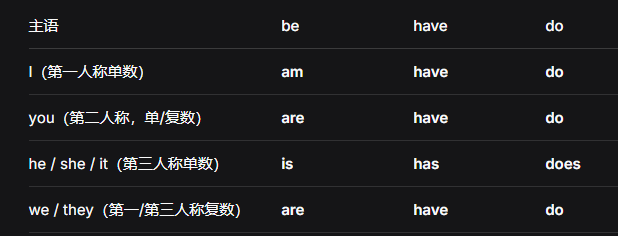
过去时也有部分人称/数区别
主要是 be:
I / he / she / it → was
you / we / they → were
而 did 所有人称同形:
I did / you did / he did / they did
had 也所有人称同形:
I had / he had / they had
情态助动词不受人称影响
can / could / may / might / must / shall / should / will / would 都不随人称变:
He can swim.(不是 cans)
She will come.(不是 wills)
They must go.
否定/半否定副词或短语置句首
常见:never, seldom, rarely, hardly, scarcely, barely, little, nowhere, not, no, not only, not until, no sooner, under no circumstances, on no account, at no time, in no way, by no means 等。
so / neither / nor 表示“也一样/也不”
I like it. — So do I.
He can’t swim. — Neither can I.
She didn’t go. — Nor did he.
地点/方向副词置句首:完全倒装
这类不是“助动词提前”,而是谓语动词整个提前,常见于 here, there, now, then, up, down, away, in, out, on 等。
Here comes the bus.
Away flew the bird.
On the wall hung a picture.
但如果主语是代词,通常不倒装:
Here he comes.(不是 Here comes he)
部分倒装:否定/限制/强调成分置句首 → 助动词/情态动词/be 提前。
完全倒装:地点/方向/表语置句首 → 谓语动词整个提前。
不是所有句首成分都倒装;关键看该成分是否属于上述否定、限制、强调或特定固定结构。
never 这类频度否定副词贴在第一个助动词 have 之后、实义动词之前
否定句里表示「也」要用 either,并且落在句末,紧跟在被否定的内容之后。too 只用在肯定句;neither 不能单独挂在句末当「也」用;also 一般不出现在否定句尾,它习惯贴在助动词后。
评论 (0)